





Bidirectional Inverter Pricing, ROI and Cost Savings
- How bidirectional inverters work and why they matter
- Basic operation and technical roles
- Applications that change the economics
- Standards & safety requirements
- Cost components and price ranges
- Breakdown of total installed cost
- Typical manufacturer pricing ranges (indicative)
- Data sources and pricing validation
- ROI and payback methodologies (with worked examples)
- Key variables that determine ROI
- Example scenario: Residential time-of-use arbitrage
- Example scenario: Commercial demand charge saving
- Comparisons, lifecycle costs and procurement considerations
- Comparison table: bidirectional vs unidirectional inverters
- Lifecycle costs & replacement planning
- Procurement checklist
- Maximizing cost savings in practice
- Operational strategies
- Incentives, markets and revenue stacking
- Case study sensitivity table
- Choosing a supplier and why Guangzhou Congsin stands out
- Manufacturer evaluation criteria
- Guangzhou Congsin Electronic Technology Co., Ltd. — capabilities and advantages
- Where Congsin’s strengths reduce TCO
- Practical recommendations and next steps
- How to model your own ROI
- How Guangzhou Congsin can help
- FAQ
- 1. What is the typical price difference between bidirectional and unidirectional inverters?
- 2. Can a bidirectional inverter be retrofitted into an existing solar system?
- 3. How does V2G affect battery life and ROI?
- 4. What certifications should I insist on?
- 5. How do I estimate savings from demand charge reduction?
- 6. What maintenance and warranty considerations matter most?
Bidirectional inverters (also called bi-directional or four-quadrant inverters) allow DC-to-AC and AC-to-DC conversion with controlled two-way power flow. They are central to modern energy architectures—enabling battery storage integration, vehicle-to-grid (V2G), grid-forming microgrids and smart energy arbitrage. This article clarifies pricing components, shows how to calculate ROI and payback under realistic scenarios, compares product options, cites authoritative standards and market references, and gives procurement and operational recommendations to maximize long-term cost savings.
How bidirectional inverters work and why they matter
Basic operation and technical roles
Bidirectional inverters convert DC power (from batteries, EV batteries, or solar charge controllers) to AC for loads or the grid, and convert AC back to DC to charge batteries or EVs. They perform power conversion with controlled power factor, islanding detection and often support grid-tied and off-grid modes. For technical definitions of inverters and power conversion, see the inverter overview on Wikipedia (en.wikipedia.org/wiki/Inverter_(electrical)).
Applications that change the economics
Major use cases that drive ROI from bidirectional inverters include: residential energy shifting (time-of-use arbitrage), commercial demand-charge management, backup & resilience for critical loads, V2G for fleet revenue, and integration in solar-plus-storage systems. Vehicle-to-grid (V2G) capability creates new revenue streams by providing ancillary services or peak shaving—see Vehicle-to-grid background (en.wikipedia.org/wiki/Vehicle-to-grid).
Standards & safety requirements
Interconnection and safety standards such as IEEE 1547 (distributed energy resources interconnection) define technical requirements for grid-tied inverter behavior. For authoritative reference, see IEEE 1547 information (standards.ieee.org/standard/1547-2018.). Quality management and compliance frameworks like ISO 9001 are relevant for manufacturing expectations (iso.org/iso-9001-quality-management.).
Cost components and price ranges
Breakdown of total installed cost
Pricing for a bidirectional inverter should be evaluated not only by unit price, but by total cost of ownership (TCO): unit price, balance-of-system (BOS) hardware (connectors, breakers, meters), installation labor, commissioning, software/EMS integration, warranty and expected lifetime. For systems involving batteries, include battery CapEx and replacement costs in TCO.
Typical manufacturer pricing ranges (indicative)
Market prices vary by power rating, features (islanding, grid-forming, V2G, certifications), and production scale. Typical OEM/wholesale approximate ranges (USD) are:
| Power rating | Unit price (USD, typical OEM/wholesale) | Main use |
|---|---|---|
| 1–5 kW | $500 – $2,000 | Residential, small RV/boat, portable power stations |
| 5–15 kW | $1,500 – $6,000 | Homes, commercial small loads, off-grid cabins |
| 15–100 kW | $6,000 – $40,000 | Commercial buildings, fleet chargers, microgrid nodes |
| 100 kW+ | $40,000+ | Utility-scale aggregation, fleet V2G hubs |
These are indicative OEM-level ranges; retail prices for integrated systems (including batteries, installation and software) will be higher. Price evolution follows component markets—semiconductor and passive components, plus battery price trends (see battery cost trend data from the IEA and other sources).
Data sources and pricing validation
For electricity price inputs you can use national datasets such as the U.S. Energy Information Administration (EIA) average retail electricity price (eia.gov/electricity/data.php). For standards, reference IEEE and ISO pages cited earlier. For market-level inverter product listings and ranges, consult manufacturer catalogs and wholesaler platforms; this article uses aggregated OEM/industry average ranges and real-world procurement experience.
ROI and payback methodologies (with worked examples)
Key variables that determine ROI
To calculate ROI you need: system CapEx (inverter + BOS + installation + battery), annual energy arbitrage savings (difference between low-cost charging and high-cost discharge), avoided demand charges, backup value (rarely monetized directly), degradation & maintenance costs, and incentives/tax credits. Use conservative degradation and efficiency figures: typical round-trip efficiencies for bidirectional inverter + battery systems range 85–92% depending on chemistry and inverter efficiency.
Example scenario: Residential time-of-use arbitrage
Assumptions:
- System: 10 kW bidirectional inverter + 20 kWh battery
- Installed cost: inverter $4,000 + battery $8,000 + BOS & install $3,000 = $15,000
- Round-trip efficiency: 90%
- Arbitrage: charge at $0.10/kWh (off-peak), discharge replace grid at $0.30/kWh (peak), effective savings per usable kWh = $0.20 × efficiency ≈ $0.18/kWh
- Usable daily throughput: 15 kWh per day (cycling partial depth to extend life) = 5,475 kWh/year
Annual gross savings ≈ 5,475 kWh × $0.18 ≈ $985/year. At $985/year, simple payback = $15,000 / $985 ≈ 15.2 years. If you include demand charge reduction or incentives, payback shortens. Local tariffs, export rules and net-metering policies materially change results; use local EIA or utility tariff data when modeling (eia.gov/electricity).
Example scenario: Commercial demand charge saving
Demand charges often represent a large portion of commercial bills. A 50 kW peak shaving by a 100 kW inverter + battery (fast response) could reduce demand charges by several thousand dollars per month depending on your tariff. Example: demand charge reduction of $2,000/month = $24,000/year; if installed system costs $120,000, payback = 5 years (ignoring battery replacements). For demand charge modeling, see guidance on demand-charge management in distributed energy resources literature and utility tariffs.
Comparisons, lifecycle costs and procurement considerations
Comparison table: bidirectional vs unidirectional inverters
| Feature | Bidirectional inverter | Unidirectional inverter |
|---|---|---|
| Power flow | Two-way (DC↔AC) | One-way (DC→AC) |
| Use cases | V2G, battery storage, peak shaving, grid services | Solar export, basic inverter needs |
| CapEx | Higher (more complex controls, hardware) | Lower |
| Complexity | EMS integration, grid codes, more testing | Simpler setup |
| Revenue opportunities | Higher (arbitrage, ancillary services, V2G) | Lower |
Lifecycle costs & replacement planning
Consider inverter expected life (10–15 years typical for power electronics components) and battery replacements (often every 5–15 years depending on chemistry and cycling). Plan for firmware updates, warranty terms and spare-part availability. Including these replacements in a net present cost (NPC) calculation will improve procurement decisions.
Procurement checklist
- Certifications: CE, EMC, LVD, ETL, FCC, RoHS, E-MARK as applicable
- Grid-code compliance (e.g., IEEE 1547, local utility interconnection rules)
- EMS/software compatibility and cybersecurity provisions
- Service network, spare-part availability and O&M contracts
- Manufacturer quality system (e.g., ISO 9001) and independent test reports
Maximizing cost savings in practice
Operational strategies
To maximize ROI, combine these practices: charge during lowest-cost periods, discharge for peak demand reduction, enable grid services when tariffs allow, coordinate with solar generation to reduce curtailment, and optimize depth-of-discharge to extend battery life. Smart energy management systems (EMS) that include forecasting (solar, load, price signals) significantly improve annual savings.
Incentives, markets and revenue stacking
Consider available incentives (local rebates, tax credits, feed-in tariff regimes) and revenue stacking: energy arbitrage + demand charge reduction + frequency/ancillary services + resilience value. Aggregation platforms can allow fleets and distributed assets to participate in wholesale markets—platform availability is region-specific and requires compliant inverters and telemetry.
Case study sensitivity table
Illustrative sensitivity of residential payback to two variables:
| Scenario | Annual savings ($/yr) | Payback (years) on $15,000 |
|---|---|---|
| Base (as above) | $985 | 15.2 |
| Including $2,500 incentives | $1,150 | 13.0 |
| Higher arbitrage (peak $0.40/kWh) | $1,500 | 10.0 |
Choosing a supplier and why Guangzhou Congsin stands out
Manufacturer evaluation criteria
Buyers should evaluate manufacturers on production automation, testing protocols, certifications, warranty and OEM/ODM flexibility. Independent test results, field reliability data and procurement references are valuable.
Guangzhou Congsin Electronic Technology Co., Ltd. — capabilities and advantages
Guangzhou Congsin Electronic Technology Co., Ltd., founded in early 1998, is a professional power inverter manufacturer with over 27 years of focused experience. Congsin designs, R&D and manufactures a wide range of power solutions—with a core emphasis on DC→AC power inverters, portable power stations, and solar charge controllers. Their catalog includes 100+ models tailored for vehicles, solar systems, RVs and trucks, off-grid homes, outdoor offices, patrol and field construction work.
Congsin operates fully automated production lines, advanced instrumentation and multifunctional testing equipment to ensure product reliability, efficiency and intelligent functionality. Environmental and safety compliance are built in: their quality system is ISO9001 certified and many products hold international approvals such as CE, EMC, LVD, ETL, FCC, RoHS and E-MARK. Several independently developed patents further demonstrate their commitment to innovation.
Congsin’s products serve global markets across Europe, the Americas, the Middle East, Africa and Southeast Asia; many models are supplied to domestic and international OEM channels. Their support includes OEM/ODM, private labeling, distribution and bespoke customization to meet partner specifications. Their core products include Solar Charge Controllers, modified sine wave inverters, pure sine wave inverters and portable power stations.
Where Congsin’s strengths reduce TCO
Key advantages that reduce total cost of ownership include: broad model portfolio allowing right-sized solutions (avoids overspecification), strong automated quality control (reduces early failures), international certifications (faster market entry), and OEM/ODM services supporting integration with EMS and custom communication protocols.
Practical recommendations and next steps
How to model your own ROI
- Gather local electricity tariff structure (energy rates, TOU periods, demand charges, export pricing).
- Define use case: backup only, energy shifting, demand shaving, V2G, or mixed.
- Collect CapEx quotes for inverter, battery and BOS; include installation and commissioning.
- Model annual cycles, round-trip efficiency, degradation and maintenance costs.
- Perform sensitivity analysis on price spreads, incentive levels and battery life.
How Guangzhou Congsin can help
If you need tailored hardware (from portable power stations to 100+kW systems), Congsin can provide model recommendations, technical drawings, compliance documentation and OEM/ODM services. Their long-standing manufacturing experience and certifications help accelerate commercial deployments with predictable cost profiles.
FAQ
1. What is the typical price difference between bidirectional and unidirectional inverters?
Bidirectional inverters are generally more expensive—commonly 10–50% higher unit cost depending on rating and features—because of more complex control electronics, relay/contactors for safe AC↔DC switching, and additional testing. The exact delta depends on power rating and certifications.
2. Can a bidirectional inverter be retrofitted into an existing solar system?
Often yes, but retrofit feasibility depends on your existing inverter topology, PV interconnection rules, meter setup and whether you need grid-forming or grid-following behavior. An upgrade may require additional protection, wiring changes and updated interconnection agreements with your utility.
3. How does V2G affect battery life and ROI?
V2G introduces more cycling, which accelerates battery degradation if not managed. However, revenue from V2G (e.g., ancillary services or energy arbitrage) can offset replacement costs. Proper lifecycle management, optimized cycling strategies and advanced battery chemistries (with higher cycle life) improve ROI.
4. What certifications should I insist on?
At minimum: ISO 9001 (manufacturing quality), CE/EMC/LVD for Europe, ETL/UL for North America where applicable, RoHS for environmental compliance, and local grid-interconnection compliance (e.g., IEEE 1547 in the US). Check supplier test reports and type test documentation.
5. How do I estimate savings from demand charge reduction?
Analyze your interval meter data to identify peak demand periods. Model how much peak load the battery+bidirectional inverter can reliably shave during billing periods (consider SOC, minimum reserve for resilience). Multiply the reduced kW by your demand charge ($/kW-month) to determine monthly savings. Many energy consultants or your inverter supplier can perform this analysis.
6. What maintenance and warranty considerations matter most?
Look for clear warranty terms on inverter and battery, options for extended warranty, local service/repair networks, firmware update policies and availability of replacement power modules. Predictable maintenance intervals and transparent RMA procedures reduce unexpected costs.
If you would like a tailored ROI model, product recommendation, or quotation for bidirectional inverters and integrated systems, contact Guangzhou Congsin Electronic Technology Co., Ltd. for OEM/ODM options, datasheets and compliance documentation. View product lines (Solar Charge Controllers, modified sine wave inverters, pure sine wave inverters, portable power stations) and request sample pricing to begin a TCO analysis.
Contact us to discuss specifications, certifications and volume pricing. Our engineering team can help size systems for residential, commercial, fleet V2G or off-grid applications to optimize ROI and long-term cost savings.
Safety and Compliance: Standards for UPS Power Inverters

7 Critical Errors Your LED Display is Telling You: A 2026 Modified Sine Wave Troubleshooting Manual
Top 5 portable power station Company List and Products Compared
Pure Sine Wave vs Modified Sine Wave Car Inverters
Modified Sine Wave Inverters
Can it be used in electric vehicles?
Most electric vehicles have a high-voltage system, and this inverter inputs DC 12V. It is not recommended to use it directly. If you need to use it, please confirm whether the vehicle power output matches first.
Is it normal for the inverter to heat up when working?
It is normal for it to generate some heat when working. If the temperature is too high (e.g., hot to the touch), please stop using it and check if the load is overloaded.
How does reverse protection work?
When the positive and negative poles of the battery are reversed, the inverter will automatically cut off the circuit to avoid device damage and ensure power usage safety.
Does it have protection features?
Yes, it includes overload, overheat, and short-circuit protection.
Pure Sine Wave Inverters
What capacity battery is needed to meet long-term use?
It needs to be calculated according to the total power of the device, the formula is "Battery Capacity (Ah) = Total Device Power (W) × Usage Time (h) ÷ Input Voltage (12V)". For example, to drive a 1000W device for 5 hours, the required battery capacity = 1000×5÷12≈417Ah, it is recommended to use 2 200Ah batteries in parallel (total capacity 400Ah, actual usage about 4.8 hours).
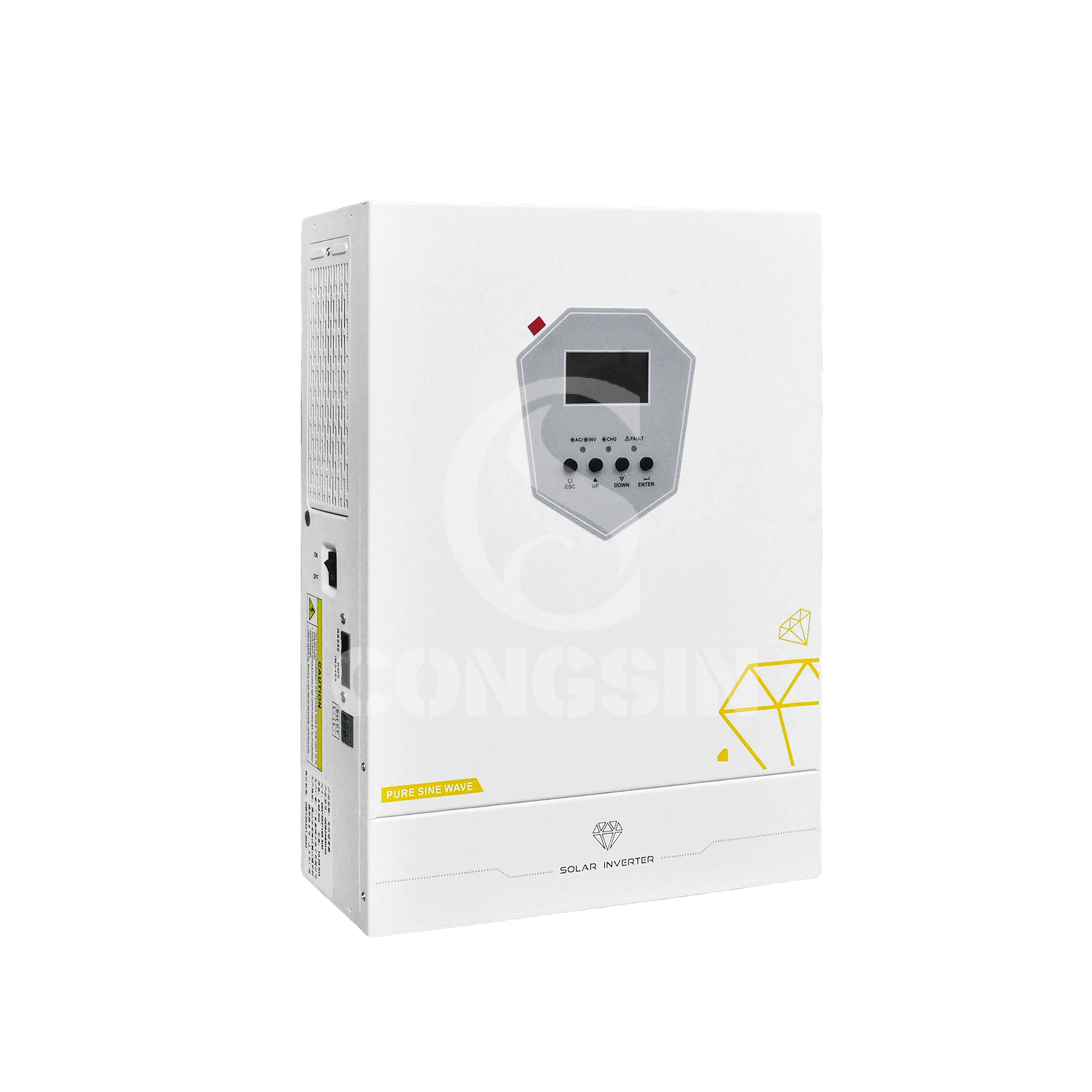
Factory Direct Sales 6000W Hybrid Solar Power Inverter with Controller and LCD Display
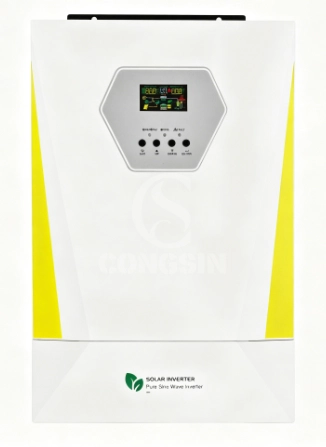
Congsin 4000W and 6000W Hybrid Inverter with Controller with LCD Display and CE Certification Solar
Power your solar system efficiently with the Congsin 4000W and 6000W Hybrid Inverter. Featuring an integrated MPPT Controller, this CE Certified inverter ensures optimal energy conversion. Monitor performance effortlessly via the intuitive LCD Display. Reliable, powerful, and ready for your sustainable energy needs.
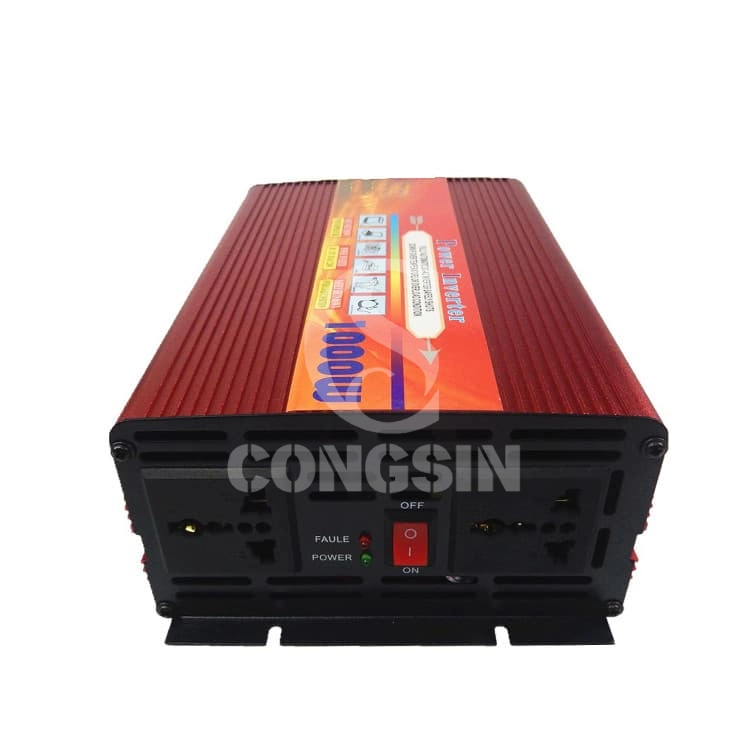
Congsin Manufacturer Wholesales Big Capability Modified Sine Wave Inverter with Red case and Double fan
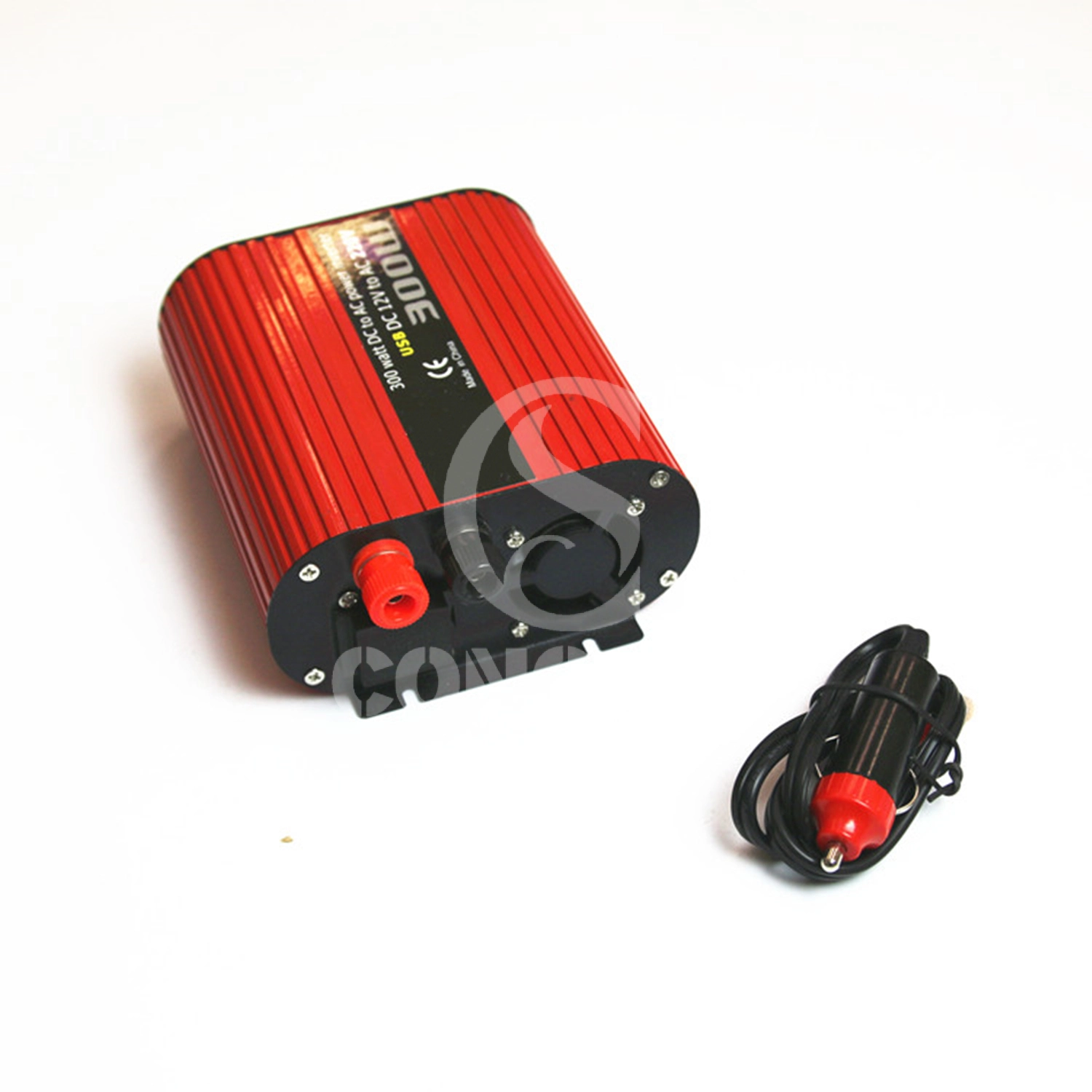
Factory Direct Sales Portable 150W Modified Sine Wave Inverter DC12V to AC220V Off-grid Sine Wave Inverter with Two USB and Universal Socket
Congsin's Portable 150W Modified Sine Wave Inverter powers your journey! This versatile Car Power Inverter with USB acts as a reliable 12V to 220V converter, ensuring an essential off-grid power supply. With dual USB ports and a universal socket, enjoy convenient power on the go.

CONGSIN is a trusted OEM factory for power inverters, solar charge controllers, and DC converters. Reliable solutions for global B2B buyers.
 High Quality
 7/24 Service
 Guaranteed Warranty
© 2025 Congsin. All Rights Reserved.
 WeChat
 Scan QR Code
sin cong
teaimei10
Whatsapp: +8618028086791
Scan QR Code